
Healing Umbrella Psychotherapy
Anti-Racist Therapy for Activists, Organizers, and People Working Toward Collective Liberation
You may be doing work that asks you to remain present to violence, injustice, grief, and conflict while still answering emails, paying bills, caring for people, and moving through your own life.
- Online therapy throughout Tennessee
- In-person therapy in Nashville
You might be organizing, teaching, providing care, challenging harm inside an institution, or trying to live differently from what you were taught.
- Perhaps you are exhausted from being the person who always notices what others ignore.
- Maybe you made a mistake and are trying to take responsibility without disappearing into shame.
- You may also be wondering how to keep showing up when your body is telling you that the current pace is no longer possible.
Therapy can hold the personal, relational, and political parts of that experience together.
We will not ask you to pretend that every source of distress begins inside your mind.
We can look at what you are carrying, where it came from, what belongs to you, and what was never meant to be carried alone.
More about this approach
You might be organizing, teaching, providing care, challenging harm inside an institution, or trying to live differently from what you were taught.
- Perhaps you are exhausted from being the person who always notices what others ignore.
- Maybe you made a mistake and are trying to take responsibility without disappearing into shame.
- You may also be wondering how to keep showing up when your body is telling you that the current pace is no longer possible.
Therapy can hold the personal, relational, and political parts of that experience together.
We will not ask you to pretend that every source of distress begins inside your mind.
We can look at what you are carrying, where it came from, what belongs to you, and what was never meant to be carried alone.
You Should Not Have to Leave Your Politics Outside the Therapy Room
Some therapy spaces become uncomfortable as soon as racism, state violence, labor, policing, immigration, disability, gender, or economic inequality enters the conversation.
A therapist may quickly redirect toward coping skills or encourage you to change your thinking about circumstances you are perceiving accurately.
-
Anger gets pathologized.
-
Exhaustion becomes a boundary problem.
-
The surrounding institution disappears,
leaving one person responsible for adapting to everything it demands.
That approach can make people feel even more alone.
Your political commitments affect your relationships, work, grief, identity, and sense of what a meaningful life could be.
They belong in therapy because they are part of how you understand the world and your place within it.
What Might Bring You to Therapy
You may be seeking support for:
Swipe or scroll to explore.
Burnout & the pace of the work
- Activist, organizer, advocate, or caregiver burnout
- Feeling numb after years of remaining alert
- Guilt about resting while other people are still in danger
- Fear that setting a boundary means abandoning the work
- Losing contact with pleasure, creativity, relationships, or your body
Racism & being made representative
- Racial trauma and the accumulated effects of racism
- Being tokenized or expected to represent an entire community
- Pressure to educate colleagues, relatives, or institutions
- Being pushed toward respectability to remain employed or heard
- Perfectionism connected to being watched, judged, or treated as representative
Conflict within the work
- Conflict inside organizing or movement spaces
- Callouts, ruptures, accountability processes, or public conflict
- Disillusionment after witnessing harm within a values-led organization
- Feeling betrayed by a workplace, nonprofit, faith community, or movement
Grief, anger & responsibility
- Grief connected to community loss, political violence, or ongoing crisis
- Anger that has nowhere safe to go
- Shame or defensiveness after causing harm
- Questions about privilege, responsibility, and complicity
Being the person others rely on
- Resentment from carrying more than your share
- Difficulty receiving care after becoming known as the person who provides it
- Wondering what your life is allowed to hold beyond struggle
Family, relationships & belonging
- Family conflict around race, religion, sexuality, gender, or politics
- Trying to raise children differently from how you were raised
- Navigating interracial, interfaith, or cross-cultural relationships
- Feeling isolated from people who do not share your values
You do not need to arrive with a polished political analysis.
Therapy can begin wherever the conflict is currently living.
Distress Has a Context
People develop survival strategies inside particular conditions.
Hypervigilance
May come from learning that authority is dangerous.
Perfectionism
May have helped you survive environments where mistakes carried unequal consequences.
Anger
May protect the part of you that knows something is wrong.
Overworking
May be tied to financial instability, family responsibility, movement urgency, or the fear that no one else will step in.
Those responses can become painful without becoming irrational.
We can examine how they formed, what they continue to protect, and what they now cost you.
The work does not require separating your nervous system from the world that shaped it.
How We Approach Anti-Racist and Liberatory Therapy


We Do Not Pretend Therapy Is Neutral
Therapy happens inside relationships where power exists.
Therapists carry credentials, institutional authority, personal histories, and social positions into the room. Clients are often expected to trust without knowing how that power will be used.
We believe trust should grow through transparency, consent, and what happens over time. You can ask questions, disagree with your therapist, name an impact, or decide that an approach does not fit.
Anger Is Allowed to Carry Information
Anger can tell us that a boundary was crossed, a loss has not been witnessed, or something important is being treated as disposable.
We will not rush to make anger quieter because it makes other people uncomfortable. We can help you understand what it is protecting and decide how you want to use its energy.
That may include protest, boundary-setting, grief, direct conversation, creative work, distance, or rest.
We Look at Power, Not Only Communication
Many conflicts are described as misunderstandings when someone has considerably more power over the outcome.
A supervisor and employee are not taking the same risk when they disagree. Neither are a landlord and tenant, citizen and undocumented family member, clinician and patient, or institution and the person filing a complaint.
Communication skills can help. They cannot erase differences in authority, money, legal protection, credibility, or access to safety.
Therapy can help you decide what is possible within those conditions without blaming you for choices shaped by real consequences.
We Take Community Seriously
Healing is often described as private work between one client and one therapist. People also recover through friendship, culture, political education, mutual aid, art, land, spiritual practice, collective action, and being known by others.
Therapy is one relationship within a much larger ecology of care.
We may explore where community has held you, where it has caused harm, and what kind of connection you want to build now. The therapist does not become a substitute for the relationships and resources that make life livable outside the room.
We Make Room for Accountability Without Treating People as Disposable
People cause harm, including people with strong politics and caring intentions.
Accountability may require listening without immediately defending yourself, understanding the impact, changing your behavior, giving someone space, accepting a consequence, or addressing the conditions that allowed the harm to continue.
Shame can make repair harder when it turns the entire conversation toward proving that you are still a good person.
Therapy can help you remain present to what happened without asking the harmed person to comfort you or grant immediate forgiveness.
Swipe or scroll to explore each part of our approach.
When the Harm Happens Inside the Movement
Values-led spaces can reproduce the same hierarchy, exploitation, racism, ableism, transphobia, or punishment they say they oppose.
That betrayal can be especially painful because the space was supposed to know better.
You may have invested years of labor, trust, friendship, or identity in the work.
Speaking about the harm may threaten your community, reputation, employment, or access to the movement itself.
You may be carrying:
Swipe or scroll to explore.
Trust & belonging
- Disappointment in people you respected
- Grief after leaving an organization or community
- Distrust of leadership and collective processes
- Isolation after a callout or rupture
Pressure & retaliation
- Pressure to remain silent for the sake of the larger cause
- Fear of public conflict or retaliation
- Exhaustion from being asked to mediate everyone else’s conflict
Repair & responsibility
- Confusion about whether repair is possible
- Anger at seeing accountability language used as a weapon
- Shame about what you participated in or failed to notice
Therapy cannot decide a community process for you.
It can give you somewhere to think without being watched, pressured to protect an institution, or asked to make a quick public statement before you understand what happened.
For Black, Brown, Indigenous, Asian, Immigrant, and Other Racialized Clients
You may already understand exactly how racism is affecting you.
You may not need another explanation of microaggressions, implicit bias, or why a workplace interaction hurt.
You may need a therapist who can stay with the cumulative reality of being watched, underestimated, tokenized, fetishized, isolated, or required to remain composed while something harmful is happening.
Therapy can hold the exhaustion of surviving racism alongside everything else in your life.
That may include:
- Family
- Migration
- Gender
- Queerness
- Disability
- Religion
- Class
- Relationships
- Pleasure
- Creativity
And the parts of you that do not exist in response to oppression.
You are more than what has been done to you.
For White People Examining Privilege and Responsibility
You may be confronting parts of your family history, workplace, community, or own behavior that are difficult to see clearly.
This work can bring
- Guilt
- Defensiveness
- Grief
- Urgency
- The desire to prove that you are different from other white people
Those reactions can quietly move attention back toward your comfort and intentions.
Therapy offers somewhere to examine them without asking racialized friends, colleagues, partners, or organizers to carry the process for you.
This is not a place to receive certification that you are one of the good ones.
It can be a place to:
- Become more honest about how power moves through your relationships.
- Tolerate correction without collapsing.
- Translate your values into decisions that cost more than a statement of support.
When Your Work Involves Caring for Others
Therapists, educators, organizers, social workers, healthcare workers, advocates, and community leaders often hold stories that cannot be easily put down.
You may be expected to remain calm while witnessing preventable harm.
You may work within an institution whose policies contradict what the people you serve need.
There may be legal, ethical, or financial limits on what you can change.
Over time, this can lead to grief, anger, numbness, moral distress, and a sense that your work is consuming the reasons you entered it.
Therapy can help you think about:
Role & responsibility
- The difference between your role and your responsibility
- What belongs to you and what belongs to the institution
- Conflict between professional rules and personal values
What stays with you
- Grief over outcomes you could not control
- The emotional consequences of witnessing harm
- Shame about mistakes or missed opportunities
Space to receive care
- How to remain connected without becoming permanently available
- Receiving care when you are usually the person providing it
Your relationship to the work
- Whether your current role is still sustainable
- What a different relationship to the work could look like
Your usefulness to other people is not the full measure of your life.
Meet Our Therapists
You may want a therapist who understands the effects of racism and marginalization, life between cultures, religious harm, queerness, neurodivergence, advocacy, and the complicated work of trying to live your values.
Scroll or swipe to explore our therapists
 He/Him
Troy Morrow MSSW
Queer, Black, and Neurodivergent Therapist
Troy works with people navigating racial marginalization, queer and trans identities, ADHD, autism, chronic illness, disability, trauma, relationships, and major life changes.
- Available
- Online throughout Tennessee
- Fees
- Deep sliding-scale availability
More about Troy
His approach names the unfair systems people move through without reducing them to what those systems have done. Troy may be a good fit for students, artists, activists, community members, and people trying to reconnect with their own values after years of being pushed to work against themselves.
He brings lived experience as a Black, pansexual, polyamorous, neurodivergent person living with chronic illness, as well as a background in research.
- Approaches
- Narrative, cognitive, mindfulness-based, somatic, expressive, and exploratory therapy, with EMDR training
 She/Her
Dani Neiderhiser MA
Bilingual LGBTQ+ Therapist
Dani works in English and Spanish with people navigating sexuality, gender, culture, religion, body image, shame, and life between communities.
- Available
- Online throughout Tennessee and in person in Nashville
- Languages
- English and Spanish
More about Dani
Having lived across different countries and cultures, Dani understands how identity can be shaped by migration, language, belonging, and environments that ask people to hide or question parts of themselves. She may be a good fit for people examining what they were taught about gender, religion, bodies, and whose ways of living are treated as legitimate.
Her work is grounded in empathy, curiosity, and the belief that shame rarely helps people change.
- Areas of focus
- LGBTQ+ identities, Hispanic and Latina/o/e communities, religious trauma, body image, eating concerns, sex-positive care, and cross-cultural identity
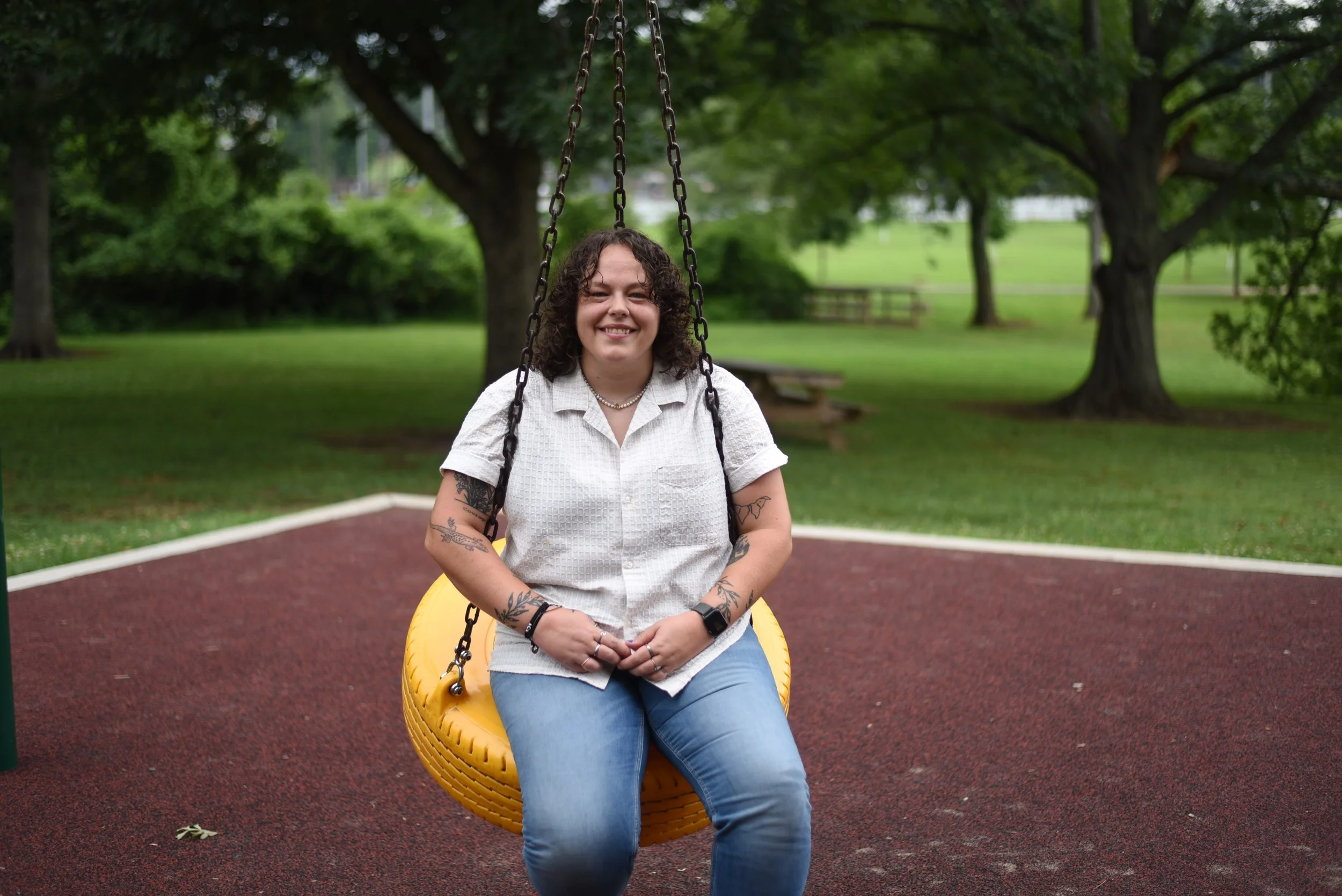 She/Her
Frankie Franklin MSSW Candidate
LGBTQ+ Therapist Intern
Frankie works with LGBTQ+ adults and youth, trans and nonbinary people, neurodivergent adults, trauma survivors, caregivers, and parents of LGBTQ+ children.
- Available
- Online throughout Tennessee and in person in Nashville
- Fees
- Deep sliding-scale rates available
More about Frankie
Her path into social work was shaped by her own queer identity, religious trauma, neurodivergence, advocacy, and movement away from the conservative thinking of the small town where she grew up. Frankie’s approach makes room for contradiction, mess, and the slower work of deciding which beliefs remain yours.
She may be a good fit if you are navigating church harm, anxiety, perfectionism, identity, relationships, or the emotional weight of fighting for the rights and dignity of people around you.
- Areas of focus
- LGBTQ+ identities, anxiety, childhood trauma, religious trauma, perfectionism, relationships, neurodivergence, caregivers, and advocacy
Frequently Asked Questions
Do I need to identify as an activist or organizer?
No. You may be involved in formal organizing, working inside an institution, supporting people in your community, trying to interrupt harm within your family, or simply attempting to live according to values that differ from what you were taught.
Can I talk openly about politics in therapy?
Yes. Politics affect material conditions, relationships, identity, safety, healthcare, work, and community. They are not treated as an irrelevant distraction from your mental health.
Your therapist may still ask questions, offer another perspective, or help you notice when a belief is affecting your relationships. Political alignment does not require pretending that every choice is beyond examination.
Is this therapy only for people of color?
No. This page includes support for people directly affected by racism and for people examining their own relationship to race, privilege, and responsibility.
The conversation will differ depending on your experiences and social position. Therapy should not pretend that everyone is entering it with the same risks or power.
Do you work with racial trauma?
Our therapists can support clients navigating racial marginalization, discrimination, identity, trauma, and the cumulative stress of moving through racist environments. A free consultation can help determine which therapist’s experience and approach best fit what you are seeking.
Can therapy help with activist or organizer burnout?
Yes. Therapy can help you understand the emotional and physical effects of sustained organizing, advocacy, caregiving, or crisis response.
The work may include boundaries and nervous-system support, while also acknowledging inadequate funding, unequal labor, institutional harm, and the political conditions contributing to the burnout.
What if I caused harm within my community?
You can bring that into therapy.
Your therapist will not offer instant absolution or reduce you to the worst thing you have done. Therapy can help you understand the impact, remain present through shame or defensiveness, and identify what accountability may require from you.
Will my therapist agree with everything I believe?
Probably not. A politically aware therapy space still includes curiosity, challenge, and honest conversation.
The therapist’s role is not to reward you for having the correct language. It is to help you understand yourself, your relationships, your impact, and the choices available to you.
Is therapy a replacement for organizing or community care?
No. Therapy cannot replace material support, political education, community, collective action, cultural practice, or structural change.
It can be one place where you process what the work asks of you and consider how you want to continue participating.
Do you work with therapists, educators, healthcare workers,
and nonprofit staff?
Yes. People in care-based and service roles may seek therapy for burnout, moral distress, institutional conflict, grief, secondary trauma, identity, or questions about how to remain in the work without abandoning themselves.
Is online therapy available outside Nashville?
Yes. Online therapy is available to clients physically located in Tennessee during their sessions. In-person availability in Nashville depends on the therapist.
Do you accept insurance?
Healing Umbrella is a self-pay practice. Depending on your insurance plan, you may be eligible for out-of-network reimbursement. Deep sliding-scale options may be available through therapist interns or clinicians with reduced-fee openings.
Contact the practice for current rates and availability.
Whatever Home Means Right Now, We Can Begin There
Home may be Tennessee. It may be somewhere else. It might be a person, a language, a meal, a faith practice, or a place you cannot safely return to. It may also be something you are still trying to build.
You do not need a neat story about where you belong before reaching out. Therapy can make room for the life you have built, the people and places you miss, the parts of culture you want to carry, and the parts you are still questioning.
Whether you are seeking support for yourself, your child, your partner, or your family, our team can help you find a therapist who will take the full context of your life seriously.
In-person therapy in Nashville
Online therapy throughout Tennessee